

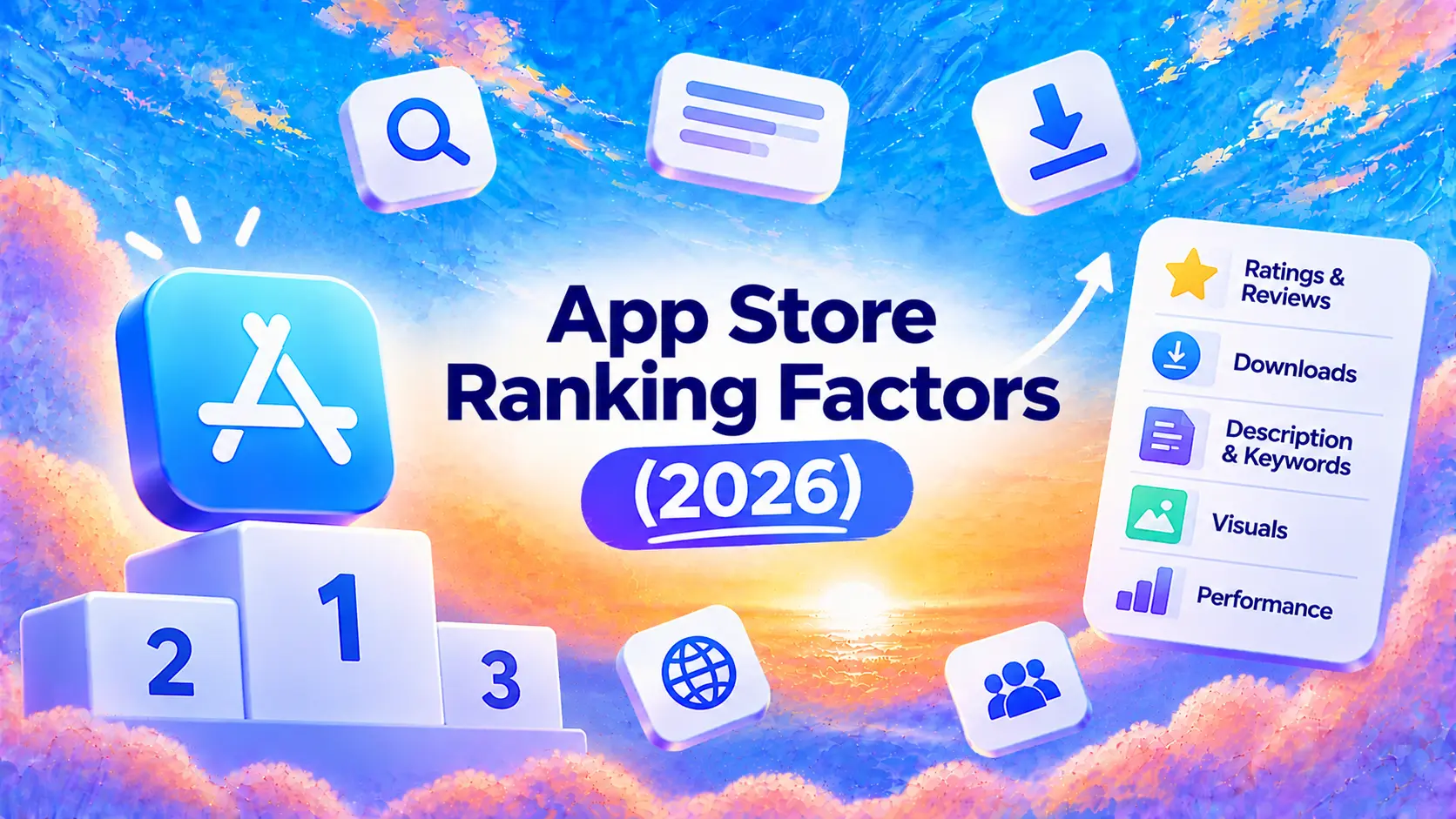
What are the App Store ranking factors in 2026?
Apple’s App Store search guidance identifies metadata relevance and behavior signals. It does not publish their weights. Use the distinction below to choose useful work without turning assumptions about the algorithm into rules.
| Factor | What is known | What to do |
|---|---|---|
| Keyword relevance | Apple names the app name, subtitle and keyword field. | Describe the app’s real purpose with relevant search terms. |
| Downloads | Apple names downloads; the time window and weights are undisclosed. | Compare download volume and velocity with acquisition sources. |
| Ratings and reviews | Apple says they can influence search positions. | Resolve recurring issues and request feedback appropriately. |
| Category | Primary category contributes to relevance; both categories are indexed. | Choose categories that match the core experience. |
| Engagement | No specific retention or engagement metric is identified in this guidance. | Monitor product health without assuming a known ranking weight. |
This guide concerns organic keyword search. Category charts measure something different. Read how App Store search ranking works for storefront differences, Top Charts and daily position changes.
1. Keyword relevance: help Apple understand your app
Begin with searches that match the problem your app solves. A clear app name, a descriptive subtitle and additional terms in the keyword field give search useful context.
For example, an interval timer could target phrases about workout intervals if those features are present. Adding unrelated popular searches gives people a misleading promise. Apple warns against irrelevant keywords and repeating words already present in the name, subtitle or category.
Promotional text is not a search ranking input according to Apple. Write your description and promotional text to help people decide to download, while keeping keyword planning focused on the relevant metadata.
2. Download volume and velocity
Downloads appear in Apple’s list of user behavior signals. Volume describes how many installs arrive during a period. Velocity describes the pace at which they arrive. The distinction helps you compare steady acquisition with a campaign spike; it does not reveal Apple’s internal calculation.
There is no published number of daily installs that guarantees a top position. A campaign, seasonal demand or editorial exposure may change downloads and visibility together. Separate acquisition sources and compare several observations before attributing a ranking increase to downloads alone.
3. Ratings and reviews
Apple states that ratings and reviews can influence search ranking. They also appear where people evaluate your app, so they can affect the decision to install. A recurring complaint is a useful starting point for a product fix.
Prioritize the underlying experience: crashes, confusing onboarding or a feature that fails its promise. Ask for feedback at an appropriate point and respond constructively. Apple publishes no universal minimum review count or star rating that secures a rank.
4. Primary and secondary categories
The primary category is part of Apple’s stated text relevance criteria. Apple also says its search algorithm indexes the optional secondary category. Categories influence browsing and filtering as well as providing context for search.
Follow Apple’s category guidance: choose the category that best represents the app’s main function and where its audience expects to find it. A less competitive category is useful only if it accurately describes the app. An unrelated choice can lead to App Review rejection.
5. Engagement and retention: useful metrics, undisclosed weights
Do new users complete the main task? Do they return? Retention and repeat use help you assess whether acquisition brings people who value the product. They can guide improvements that address dissatisfaction and support better feedback.
Apple’s search overview leaves its behavior factors open-ended, but does not identify a specific engagement or retention metric. Treat claims about exact session-length or retention thresholds as hypotheses unless supported by further evidence. Track those measures for product health alongside rankings.
Does updating your app improve ranking?
An update alone has no documented automatic search boost. What changes inside the release matters: relevant metadata can improve matching, clearer screenshots can help conversion, and fixes can address the problems behind negative reviews.
Release useful improvements and keep a log of what changed. If a position rises afterward, consider competing apps and acquisition changes too. Frequent releases by themselves do not establish a ranking benefit.
ASO vs. SEO: factors compared
App Store Optimization helps people discover an app and decide to download. Search Engine Optimization helps people find a website through web search. Both begin with search intent, but they work with different information.
| Area | ASO for iOS | Web SEO |
|---|---|---|
| Relevance | App name, subtitle, keyword field and categories | Useful content, page titles, headings and descriptive links |
| Discovery | Indexed listing metadata and app availability | Crawlable pages, internal links and accessible resources |
| Other considerations | Apple names downloads, ratings and reviews as search signals | Links help search engines find and understand pages |
| Conversion goal | App downloads from listing visits | The website’s intended action after a search visit |
| Measurement | Keyword-country positions and App Store Connect | Search Console and website analytics |
Google’s SEO Starter Guide covers the web side. For an app-focused workflow, read what ASO is and how to get started.
Turn ranking factors into a measurable plan
- Choose relevant keywords and countries. Build a shortlist using the keyword research guide.
- Record a baseline. Save positions and the existing metadata before the release.
- Log the change. Note metadata edits, product fixes and campaigns with their dates.
- Review several measurements. Compare positions with search impressions, conversion and downloads in App Store Connect.
The App Store rank tracker keeps keyword positions by country. Top-100 keywords are checked daily; keywords outside that range are checked every three days. Use the history to spot sustained changes and decide what to investigate next.